
Time as a Work of Art – Ernst Raphael Jockels and the Fascination with Rare Rolex Chronographs
A gold Rolex Cosmograph from the 1970s, a legendary stainless-steel Daytona, and an art dealer with a keen sense for history and originality: Ernst Raphael Jockels moves within two worlds of collecting that are more closely linked than they might appear at first glance.
When time becomes a collector’s item
There are objects whose value cannot be explained solely by their material, function, or age. A painting by A. R. Penck is one such example; another is a vintage Rolex Cosmograph. Both are masterworks of craftsmanship and testaments to a specific era; they tell stories and exert a fascination that extends far beyond their original purpose—captivating people of all ages and financial backgrounds across the globe.
Ernst Raphael Jockels is one of the few individuals who not only navigates both of these worlds but also bridges them—or, in some instances, brings them together entirely. An internationally active art dealer who has long focused on significant works of post-war German art, he has been equally dedicated to trading exceptional twentieth-century wristwatches. Over the past three decades, he has frequently succeeded in sparking an interest in his rare timepieces among collectors of his art—and vice versa. Ultimately, the questions surrounding rare watches are the same as those that are pivotal in the art trade: What makes an object unique? What story does it carry within itself? How can its authenticity be verified? And why do certain works or objects become coveted, nearly priceless icons, while others fade into oblivion?
A fine example of this is the gold Rolex Oyster Cosmograph from the 1970s—a timepiece whose appearance speaks of an era when technological progress, automotive speed, and a sense of social awakening merged into a new aesthetic—which Jockels discovered and acquired toward the end of the last century, later facilitating its transfer to a new owner.
A golden rarity from an era of new beginnings
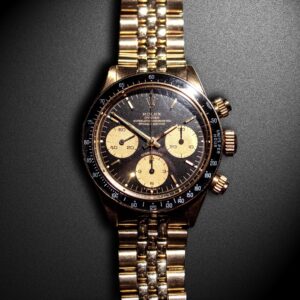 With its deep-black dial, three light-gold sub-dials, black tachymeter scale, the warm yellow gold of the case, and an elegant, exceptionally rare Jubilee bracelet, this historic Rolex Cosmograph reveals a remarkable quality of design at first glance.
It is both a precision instrument and a piece of jewelry—a sports chronograph that embodies the kind of elegance characteristic of the 1970s. Its design evokes the golden age of international motorsport: legendary racetracks, sleek sports cars, and a society that increasingly associated speed with progress and personal freedom.
The Rolex Oyster Cosmograph Daytona reference 6263 presented here dates from 1975 or 1976 and belongs to the exceptionally rare gold versions from the early generation of the Daytona. While most examples of this reference were crafted in stainless steel, collectors estimate that only about 725 pieces were produced in gold, compared to approximately 25,000 stainless steel models.
A particular rarity is the version crafted in **solid 14-karat gold (585 gold)**. It is believed that only about 50 such pieces were produced, all of which were intended exclusively for the American market. A gold hallmark on the folding clasp attests to this unique feature, making this variant one of the rarest and most highly sought-after versions of the vintage Rolex Daytona.
Inside, the legendary column-wheel chronograph caliber—based on the Valjoux 727—is at work; it is a mechanical masterpiece whose precision and elaborate craftsmanship embody the technical quality of this generation of watches.
However, it is not just its rarity that makes the Daytona offered by Ernst Raphael Jockels so exceptional. The timepiece is in near-mint condition; the original dial is as remarkably well-preserved as the case. Furthermore, it comes with the highly sought-after, rare Jubilee bracelet, which is in just as pristine a condition as the watch itself. It is precisely this combination of exceptional specifications, originality, and state of preservation that makes this chronograph a truly remarkable collector’s item.
For rarity alone does not make a legend. It is the interplay of design, history, technical perfection, and condition that elevates certain historic timepieces to the status of museum-quality collector’s items. A rare dial variant, an original bracelet, the pristine surface of a case preserved over decades, or a documented provenance—all of these can be of critical importance to collectors.
The gold Daytona from the collection of Ernst Raphael Jockels impressively illustrates these distinctive qualities. It combines the rarity of a version produced in only very limited numbers with the authenticity of an exceptionally well-preserved historical timepiece—qualities that also won over its buyer.
And therein lies the parallel between a rare historical timepiece and a significant work of art: both are unrepeatable testaments to their era, whose distinct value derives from their originality, history, and authenticity.
The stainless steel Daytona: A legend of motorsport
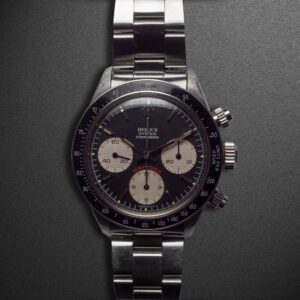 The gold Cosmograph is just one example of the rare timepieces that Jockels has brokered. Another equally fascinating example is this historic stainless steel Rolex Cosmograph Daytona, reference 6263—the so-called “Big Red” (the model shown dates from 1987, as evidenced by the accompanying certificates). The stainless steel Daytona: a legend of motorsport.
Its black dial, featuring three light-colored sub-dials and the signature red “Daytona” lettering, embodies a different facet of the same era. Here, the watch’s sporting pedigree comes to the fore more clearly. The cool metal, functional design, and high-contrast typography are reminiscent of the instrumentation found in classic race cars.
The name Daytona refers to the famous racetrack in Florida and Rolex’s close association with international motor racing.
What began as a functional chronograph for a sport-oriented clientele evolved over the decades into one of the most significant areas of horological collecting. The reference 6263 “Big Red” stands out as an exceptionally rare and highly coveted stainless-steel chronograph from the classic Daytona generation. Among collectors, it is considered one of the most attractive and sought-after versions within this legendary model series.
The specimen brokered by Jockels comes from a significant private collection and is in an exceptionally good state of preservation—virtually as if new. It is precisely this combination of rarity, outstanding condition, and distinguished provenance makes the watch a sought-after collector’s item.
The early, manually wound Daytona models, in particular, hold a special status today. Their design is an expression of an era when mechanical precision could still be experienced firsthand—through the winding of the mainspring, the operation of the chronograph pushers, and the subtle resistance of a meticulously engineered movement.
Unlike modern electronic timepieces, a mechanical chronograph turns the act of measuring time into a sensory experience.
And unlike the gold Cosmograph—whose appeal thrives on a deliberate interplay between luxury and sportiness—the stainless steel Daytona “Big Red” conveys an almost understated, functional elegance.
Two distinct personalities. A shared history.
The Zenith-Daytona – a technical revolution at the turn of the millennium
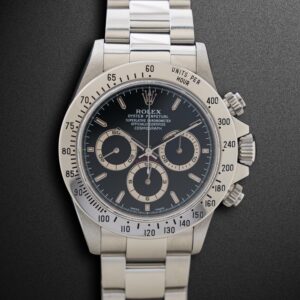
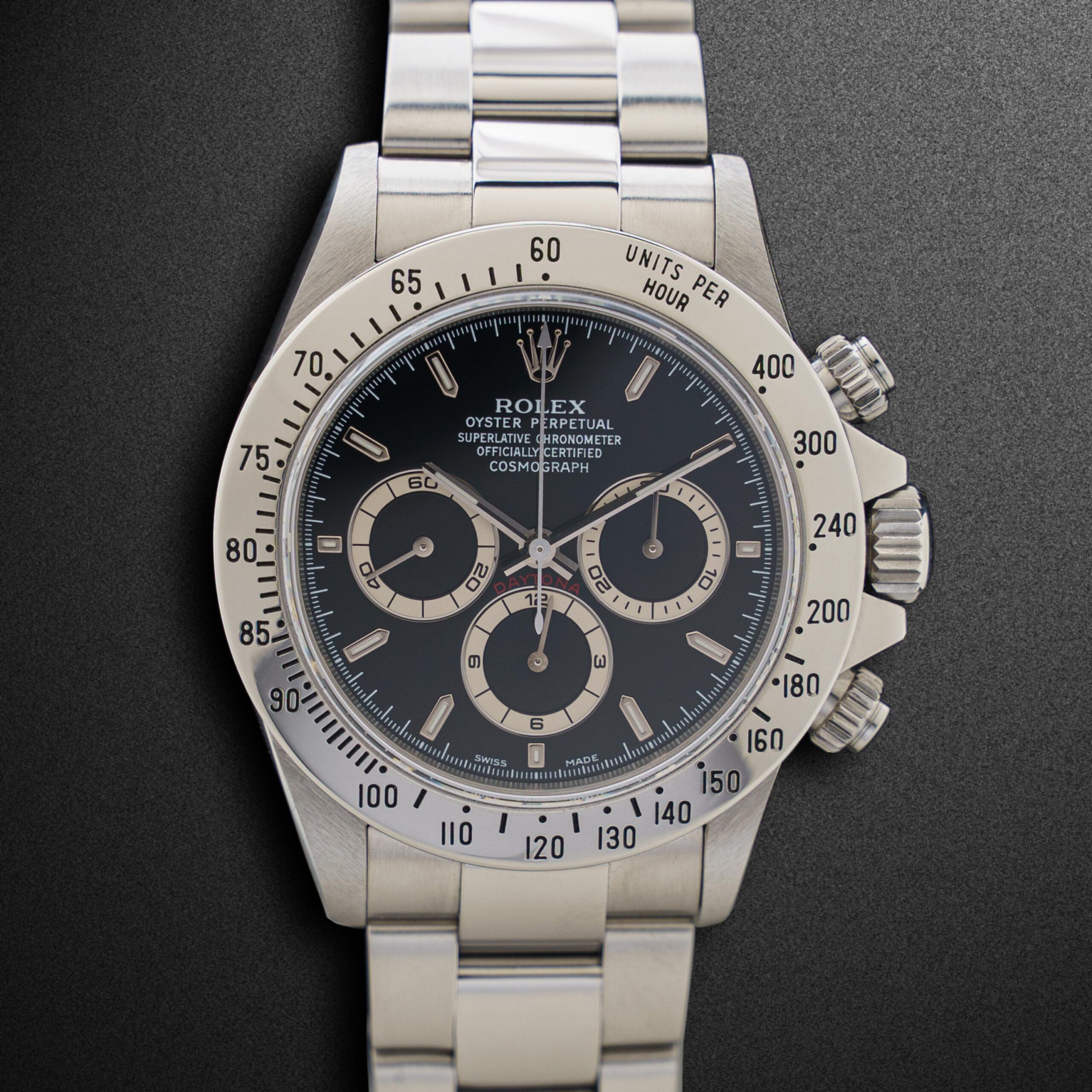
Another notable example offered by Ernst Raphael Jockels is a stainless steel Rolex Oyster Perpetual Cosmograph Daytona, reference 16520, dating from the year 2000. It belongs to the final generation of the so-called “Zenith-Daytona”—the series with which Rolex introduced its first automatic chronograph to the legendary Daytona collection in 1988. The technical heart of these watches traces back to one of the most significant chronograph movements in the history of Swiss watchmaking: the El Primero caliber, unveiled by Zenith in 1969.
With its then-revolutionary frequency of 36,000 vibrations per hour, it ranked among the world’s first high-frequency automatic chronographs, enabling the mechanical measurement of tenths of a second. Rolex, however, did not adopt this technical feat in its original form; instead, the company developed its own caliber, the 4030. More than half of the components were replaced or modified, and the frequency was reduced to 28,800 vibrations per hour to enhance both reliability and ease of maintenance.
The Daytona offered by Jockels—featuring a black dial, silver-rimmed sub-dials, and a polished stainless steel bezel—embodies this significant developmental milestone with particular elegance. Its production year, 2000, lends it additional historical weight: it was in this year that Rolex retired the Zenith-based movement, ushering in a new generation of chronographs powered by the caliber 4130—a movement developed entirely in-house.
Consequently, this Daytona marks the conclusion of a remarkable era in which two of Switzerland’s most prominent watch manufacturers combined their technical expertise into a single timepiece. It is a fascinating piece of horological history, the significance of which extends far beyond its function as a precise instrument for measuring time.
The Rolex Daytona 6262 – a rarity among rarities
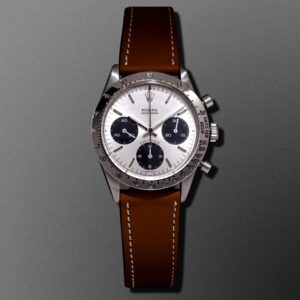
Another exceptional timepiece that passed through the hands of Ernst Raphael Jockels is the Rolex Cosmograph Daytona, reference 6262. It ranks among the rarest iterations in the early history of the Daytona and marks a significant technical transition.
In the late 1960s—likely 1969—Rolex introduced an evolved chronograph movement, the Valjoux 727, which featured a balance wheel oscillating at 21,600 vibrations per hour, an increase from the previous 18,000. This higher frequency allowed for greater precision in timekeeping, while the exterior design remained largely faithful to the legendary reference 6239. The production run of the 6262 was remarkably brief; it is believed to have ceased around 1970, whereas its technically closely related sibling model, the 6264, remained in production until approximately 1972.
Excluding specialized jeweled versions such as references 6269 and 6270, the 6262 is considered one of the rarest classic Daytonas ever produced. Examples in yellow gold, in particular, are among the greatest rarities in the model’s history. The stainless-steel version handled by Jockels—featuring a silver-colored dial, black sub-dials, and a brown leather strap—embodies the understated, almost instrumental elegance characteristic of these early chronographs. It is a timepiece whose significance is not defined by ostentatious luxury, but rather by its technical history, its short production span, and its rarity—qualities that render it as compelling to discerning collectors as a major work of art.
Provenance as the second history of an object
Collectors of significant paintings are not interested solely in what is visible on the canvas. They want to know when and under what circumstances a work of art was created, who has owned it, which exhibitions it has been part of, and what marks the passing decades have left upon it.
The same holds true for vintage luxury watches.
Serial numbers, case hallmarks, movement numbers, dial variations, historical purchase receipts, and original warranty documents form a complex web of evidence. From these, the history of a timepiece can be reconstructed—sometimes spanning several generations.
For an art dealer like Ernst Raphael Jockels, this kind of investigative work is familiar territory. His engagement with artists such as A. R. Penck and Jörg Immendorff has repeatedly demonstrated the importance of personal documents, eyewitness accounts, and historical context in situating a work of art.
Similarly, a rare Rolex can be more than just the sum of its technical components. It can serve as a historical document, one whose significance grows with every verified piece of information regarding its provenance.
And, as with a painting, there is a caveat: while restoration may restore an object’s outward luster, it always carries the risk of erasing traces that are essential to its historical authenticity.
When Time Loses Its Price – and Gains Its Value
For years, exceptionally rare historical Rolex chronographs have been fetching remarkable prices on the international auction market. The deciding factors are not merely the brand and model, but often the most minute details: the typography on a dial, the original configuration, the condition, or a verifiable provenance.
Some extraordinary pieces have commanded seven-figure (!) prices at international auctions. While such results do not represent standard market values, they do illustrate the status that certain highly coveted collector’s items can attain under exceptional circumstances.
In this respect, the market for vintage watches follows many of the same mechanisms as the international art market: an object does not become significant simply because it is expensive; rather, it becomes expensive because a sufficient number of knowledgeable collectors are convinced of its significance—and because its unique qualities cannot be replicated at will.
Therein lies a striking paradox: a watch is originally designed to measure the passage of fleeting time—yet as a historical collector’s item, it derives its value precisely from the fact that time has passed.
Ernst Raphael Jockels: Two Worlds, an Eye for the Exceptional
Works of art and historic timepieces demand different forms of expertise. Yet, they share a common cultural core: both serve as material testaments to human imagination, craftsmanship, and historical evolution.
For Ernst Raphael Jockels, dealing in vintage timepieces is more than just an expansion of his business activities. Much like his engagement with modern art, it is a passion—one that offers a unique gateway to objects whose true significance only emerges through a deep exploration of their origins, their history, and their rarity.
The gold Rolex Cosmograph and the stainless steel Daytona perfectly exemplify this connection.
One represents the rare luxury of a bygone era; the other, the functional beauty of a legendary sports chronograph. Both illustrate how, over the decades, mass-produced industrial objects can evolve into highly coveted, historic, one-of-a-kind pieces.
A painting captures a single moment of artistic vision. A watch measures those moments as they pass.
Perhaps it is precisely this commonality that bridges the worlds of the art dealer and the watch connoisseur: the ability to see an object not merely for what it is today, but also for the history of what it once was.

Leave a Reply
Your email is safe with us.